Blackpool is often reduced to headlines about crime and deprivation but working-class artist and mum Becky Davies, otherwise known as Grumpy Girl, is asking people to look again with her pop-up exhibition, Honest, at Abingdon Market this weekend. Interview by Amber Archer.
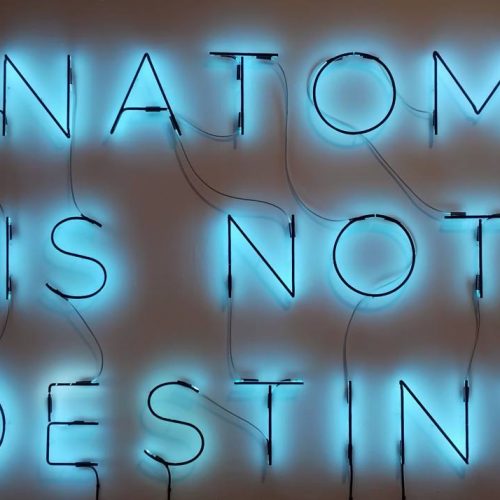
This weekend, Becky Davies is turning a retail unit in Abingdon Street Market into “Honest” an exhibition built entirely on trust. The prints themselves are risograph-printed on pink card in fuchsia ink that glows under UV light, a nod to Blackpool’s long history with illuminations and light. They’ll be left out unattended over the weekend, alongside a full, honest breakdown of everything the project has cost to make rent on the space, printing, promotion, time spent on social media so visitors can see exactly what they’re being asked to value. There’s no till and no price tag: people simply scan a QR code and pay what they feel the print is worth before taking one home.
It’s a direct response, Becky says, to the narrative she hears repeated about her hometown online and in the news and a bet that Blackpool people are more honest and more deserving of beautiful things than they’re given credit for.
What inspired you to leave your work unattended and trust people to decide what it’s worth?
The main inspiration for Honest was the fact that I’d seen that Blackpool has the highest crime rates in the UK, and also I’d started going on to TikTok and noticed the negative narrative that is around Blackpool in mainstream media and the news.
Blackpool is nothing but negative statistics, and I really just wanted to prove everybody wrong and I’m doing that at great personal risk. I believe that Blackpool people are really honest. We’re not how we’re portrayed in the mainstream media – we’re very hardworking, very honest, we’ve got a great sense of community, we’re very talented, and as a collective we all come together to support each other, and I don’t feel like that’s shared enough. So I’m trying to do something that celebrates that and to change that narrative.
Why was it important that this project happened in a public space rather than a traditional gallery?
As a working-class artist you have to spend hundreds of pounds on hiring those spaces out and also accessibility. Blackpool only has one accessible ground floor gallery, which is the Grundy.
Galleries are notoriously hard to get into, particularly for artists like me. I wouldn’t say that I’m a very established artist, and so it was about cost and making it affordable and accessible for people, and I wanted a place that I’ve had a bit of history with.
I was meant to have this exact space in Abingdon Street Market three years ago I’d already signed the contract and then I had a baby. So it’s a nice little full circle moment for me too.
Your exhibition asks people to pay what they feel. What does that say about how we value art and artists?
I think with the rise of AI art, everyone can ‘make art’ I believe everybody can make art without the use of AI, however I just kind of wanted to bring humanness back into art again.
You describe this work as changing the narrative around Blackpool. What narrative do you think that is, and how do you think it should be portrayed?
I’m really wanting it to change in the fact that I want to shine a light on the beautiful things that are in this town.
I think the main source of clickbait material that you see around Blackpool is all the negative things – it’s the drunken people on nights out, it’s the hen do’s, it’s the stag do’s, it’s the crime, it’s the teenage pregnancies, it’s the addiction rates and it’s all these very negative things. No one talks about how beautiful the sunsets are, the beautiful historic buildings that we have, all the amazing small independent artists that we have here, and all the wonderful things that are happening here like with music and drama and dance and art.
I thought let’s do something that celebrates and shines a light on that, and hopefully by doing things like this it makes it more accessible for other creatives to come along and do a similar thing.


You keep touching on accessibility, both physically and financially. As a working-class female, why do you think the art world can sometimes feel inaccessible?
Working-class artists take up less than 8% of the creative workforce. They don’t have statistics on women, but if we split it equally we’ll say women are 4% so being a working-class artist and surviving is already an achievement within itself. I’m doing the work and showing the community younger generations, older generations, everybody that just because you’re from here doesn’t mean that you can’t do these things. There are options, it’s just that you have to go about things a little differently.
Touching on that – how has growing up in Blackpool shaped your creative practice?
Blackpool’s a massive part of my art and what I do. I’m very proud to be who I am and where I’m from. You get a lot of eye rolls when you say that you’re from Blackpool – there are a lot of misconceptions, a lot of stereotypes, and I am a very typical Blackpool girl, very loud, very obnoxious, and I don’t think there’s anything wrong with that. I think that’s led into my work.
A lot of my work is about showing the town in a beautiful light. It’s about celebrating the language that we have, it’s about celebrating who we are and the struggles that we have as well.
Are you nervous about leaving the prints unattended?
I’ve been asked a lot, am I nervous about people stealing, am I nervous about people vandalising it?
I’m not nervous about leaving it at all. The only thing that I’m nervous about is that people aren’t gonna come, or people aren’t gonna take them. I think people might assume it’s just an installation, and they’ll just look. I want people to come and take them. It doesn’t concern me that people are going to steal that’s the whole reason I’m doing it. I’m doing this to prove myself right!
What conversations do you hope people have after taking one of your prints home?
I’m hoping that people are inspired to do something similar. There’s lots of retail spaces here available in Abingdon Street Market at a very affordable rate – it’s £15 a day, so hiring out a gallery space for £30 over a weekend is really good. Obviously you’re more than welcome to come and man these stalls too, but as a working-class mum, I need something that works with the flexibility of motherhood – at the weekend I want to be spending quality time with my child. I’m testing this out and seeing if it works for me as a viable way of making income too. The way that we’re working at the minute is very rigid, and I think there needs to be a lot more flexibility, because it’s hard to earn a living out here.
If this exhibition proves one thing, what do you hope that is? What’s your message to people taking a print on the day?
I’d like to prove that Blackpool isn’t exactly what it’s portrayed as in the mainstream media. I’d like to prove that we are honest and trustworthy, and that not everything is gonna get vandalised and ruined.
Just because we have the highest crime rate in the UK doesn’t mean that we don’t deserve beautiful things. We do, and I think that’s one of the biggest fears that people have when it comes to investing in the town – they’re scared those investments will be ruined by vandals, and I don’t believe that to be true. I hope people take that narrative and it gives them a bit of hope and a bit of joy.
I really want to inspire other working-class artists to get their work out there and do more unconventional things, and to trust the community to do the right thing and pay for the art.
Honest is on display at Abingdon Street Market retail space this weekend – Saturday 1st and Sunday 2nd August – from 10am-5pm. Becky invites you to scan the QR code and pay what you feel to take home your own Honest print.