[vc_row][vc_column][vc_column_text css=””]
Lytham Hall is instantly recognisable to many residents on the Fylde coast, with its impressive Georgian facade, formal gardens and small but scenic forested areas.
The weekend of the 2nd and 3rd of August brought an influx of archaeologists, both professional and voluntary, as the Hall played host to the community archaeology organisation Digventures, who have been brought in to help provide some historical basis for their ongoing project of restoration for the Hall and its grounds.
Lytham, recorded as ‘Lidun’, was named as a settlement in the The Domesday Book of 1086 – William the Conqueror’s national survey of his kingdom and its holdings, and an incredibly valuable resource for historians ever since. Increasing in importance throughout the 12th century, a church to St Cuthbert’s was built in the settlement, and then land given to the Priory of Durham for the creation of a Benedictine cell. Whilst little detail is known of the priory at Lytham, it seems likely it was small – probably no more than 2 or 3 monks at a time – and located on the site that would later become Lytham Hall. The priory itself was closed during the Dissolution of the Monasteries in the 1530s, and came into ownership of the Clifton family in the early 17th century, building a house on the site, and later rebuilding it as the hall we know today in the 1750s and 60s.
[/vc_column_text][/vc_column][/vc_row][vc_row css=”.vc_custom_1759919387770{background-color: #FFE758 !important;}”][vc_column width=”1/2″][vc_single_image image=”55735″ img_size=”medium” css=””][/vc_column][vc_column width=”1/2″][vc_empty_space height=”20px”][vc_column_text css=”.vc_custom_1759919372413{border-top-width: 5px !important;border-right-width: 5px !important;border-bottom-width: 5px !important;border-left-width: 5px !important;background-color: #FFE758 !important;border-radius: 5px !important;border-color: #417CB0 !important;}”]
“What we do at DigVentures is a social enterprise that prides itself on bringing archaeology into the hands of everyday regular people, making it as accessible as possible to everyone that has always dreamt of doing it, but maybe thought it wasn’t for them.”
[/vc_column_text][/vc_column][/vc_row][vc_row][vc_column][vc_column_text css=””]
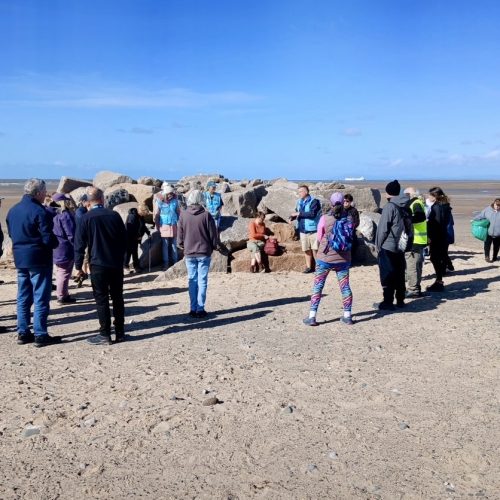
As a convalescent archaeologist myself, I headed to the Hall to find the familiar site of bodies hunched over rectangles carved into the turf. Instantly recognisable to the trained archaeological eye with the signature move of talking while pointing at the ground and then waving their hand vaguely at the horizon, I spotted a fellow digger and was introduced to the dig lead, Dr Stephanie Duensing, who spoke with me about what the excavation hoped to achieve, from both and archaeological and community-based perspective:
“What we do at DigVentures is a social enterprise that prides itself on bringing archaeology into the hands of everyday regular people, making it as accessible as possible to everyone that has always dreamt of doing it, but maybe thought it wasn’t for them. And so with that in mind, we crowdfund a lot of our digs, but we also work with other bodies like Lytham Hall (and) the Friends of Lytham Heritage Trust of the Northwest too.”
[/vc_column_text][/vc_column][/vc_row][vc_row][vc_column][vc_column_text css=””]
Bringing together a range of sources, from historical OS maps, ground penetrating radar and previous works done at the site, the Digventures team placed their test pits in an attempt to locate features from the previous gardens in the Hall grounds, ahead of a planned restoration by the Friends of Lytham Hall set for sometime in the near future, and give local volunteers the chance to experience an archaeological excavation firsthand, as Dr Duensing explains:
“We’re looking for historic traces of earlier gardens that would have been here in the 18th and 19th century. And the team of volunteers here have come to participate and help do that work. So we’re helping to train them, teach them, show them the ropes of how excavation works and letting them get stuck in.”
Due to the low physical footprint of gardens, the signs can be difficult to uncover, often represented by changes in soil colour rather than any obvious structure, especially where subsequent activity on the surface (such as a period in the 20th century where these gardens were covered by a grove of trees) can have a damaging impact on the archaeology below. However, physical artefacts can still paint a picture of the land use, with the dig uncovering an expected haul of fragments of brick, plant pots and charcoal (which would have been the main fuel source during the Victorian era), but also fragments of glass, that may have indicated the presence of a pavilion or decorative structure in the formal space.
[/vc_column_text][/vc_column][/vc_row][vc_row css=”.vc_custom_1759919525597{background-color: #FFE758 !important;}”][vc_column width=”2/3″][vc_empty_space height=”20px”][vc_column_text css=”.vc_custom_1759919506367{border-top-width: 5px !important;border-right-width: 5px !important;border-bottom-width: 5px !important;border-left-width: 5px !important;background-color: #FFE758 !important;border-radius: 5px !important;border-color: #417CB0 !important;}”]
“We’re looking for historic traces of earlier gardens that would have been here in the 18th and 19th century.”
[/vc_column_text][/vc_column][vc_column width=”1/3″][vc_single_image image=”55737″ img_size=”medium” css=””][/vc_column][/vc_row][vc_row][vc_column][vc_column_text css=””]
A further test pit was placed near the imposing garden wall, the find the continuation of this boundary where it disappears under Lytham Hall’s iconic Mount, raised in the 17th century as a prospect mount, but also housing the Hall’s ice house, which remains underneath the structure to this day.
Traces of the medieval priory have not been uncovered, with little expectation of doing so at the location or at the depth being excavated.
[/vc_column_text][/vc_column][/vc_row][vc_row][vc_column width=”1/3″][vc_single_image image=”55580″ img_size=”medium” css=””][/vc_column][vc_column width=”2/3″][vc_column_text css=””]
Further excavation work is likely, with the restoration project ongoing, and the report form the DigVentures excavation will be submitted to the Historical Environment Record, as well as the archives at Lytham Hall, with Dr Duensing expressing a wish to create a digital pamphlet that can be accessed from the Hall’s website to be made available in the future.
I also spoke with Nigel, one of the volunteers on the site, who shared his own story with the Hall and what he hoped to learn and to contribute with today’s dig:
“I’ve been volunteering here about six years. My connection with the hall actually goes back a lot further because we used to come up here for a lot of staff events and I did induction courses for new starters, so I used to come around the hall quite a lot. And I could watch all the volunteers working out my office window and I thought, when I retire, I’m going to come up here.”
[/vc_column_text][/vc_column][/vc_row][vc_row][vc_column][vc_column_text css=””]
Asked about how he was enjoying the archaeological experience, Nigel noted the difference between regular groundwork as a volunteer and the more meticulous aspects of excavation:
“We do a lot of digging here, but we do find occasional things. But obviously this is very structured and meticulous. Things that we’ve been discovering today perhaps might have got dug up because we’ve been given a project to put a path in or something. A rock might have been just taken out the way. But now we can see a bit more significance to how the rocks might be lying. And, you know, two or three of them together could signify a wall.”
Providing a valued experience for volunteers and deeper archaeological context to the expanding historical record, the DigVentures excavation is part of an ongoing program of work related to the restoration of Lytham Hall and its parkland.
If you’re interested in getting involved with volunteering at Lytham Hall, or DigVentures, or would just like to know more about the restoration project, links can be found below:
https://www.lythamhall.org.uk/
https://www.lythamhall.org.uk/
https://digventures.com/[/vc_column_text][/vc_column][/vc_row]