Blackpool Council’s £30m bid to restore the Grade II listed North Promenade colonnades could secure the future of one of the town’s most distinctive stretches of seafront. They’re a place where civic architecture, seaside spectacle and everyday community life have met for more than a century, and where recent creative work has helped demonstrate why familiar landmarks are worthy of investment.
For generations the North Promenade colonnades have been more than sea defences to Blackpool locals and visitors. The dramatic sweep of staircases, terraces and sea-facing structures run almost a kilometre along North Promenade and have offered a quieter, more picturesque part of Blackpool’s seafront.
Built in stages between 1910 and 1925, the colonnades were designed as practical infrastructure but also as part of Blackpool’s distinctive civic architecture. Their elegant curves and repeated columns were created to hold the coastline in place while shaping how people moved through it and framing views out to sea.
Historic conservation records note that earlier sea defence works here were transformed into a more formal civic frontage as Blackpool entered its booming interwar tourist years – the moment the resort established itself as Britain’s most ambitious seaside destination. Historic England added the colonnades to the Grade II list in 2021, recognising both their architectural importance and their contribution to the wider North Promenade conservation area.


But the ravages of time and the Irish Sea have left the colonnades in a state of disrepair and as a visual reminder of the British seaside’s decline. Over the last few years, some entrances to the colonnades closed for safety reasons, however earlier this year work was completed to safely reopen three of the five entrances.
Now, as part of Blackpool’s renewed sense of ambition, the Council is bidding for up to £30 million from the Department for Transport’s £1bn Structures Fund to repair and restore the Grade II listed colonnades, with work potentially completed by 2030 if funding is approved.
Their elegant curves and repeated columns were created to hold the coastline in place while shaping how people moved through it.
Part of the colonnades were designed by John Charles Robinson, then chief architectural assistant to the Borough Surveyor and later Blackpool’s Borough Architect. Robinson helped shape Blackpool’s civic identity in the early 20th century through buildings that balanced Art Deco elegance with everyday public use – including Stanley Park Cafe, Derby Baths and South Shore’s Open Air Baths, the latter two sadly now demolished.
But Robinson’s legacy has resonated with local creatives in recent years. A photography project exploring his work brought together a group of learning disabled artists – the New Langdale Photographers – and socially engaged artists to document buildings connected to him and gather stories around the communities that use them.


The project had real social value in creating space for those artists to shape how Blackpool’s built heritage is seen and understood, offering a platform for perspectives often overlooked in conversations about place and architecture. Familiar landmarks were reframed through a different lens, inviting viewers to pause and notice details, textures and histories that can easily disappear into the everyday.
Read our feature on the New Langdale photography project here.
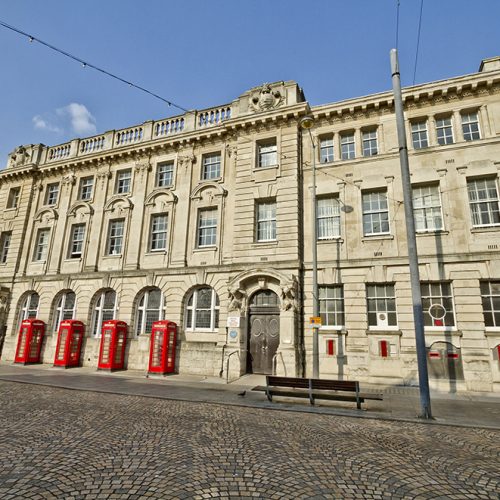
This renewed focus to structures that had been taken for granted, and in many cases lost altogether, appears to have had a real impact. If restored, the colonnades will be the second Robinson structure to receive investment since the New Langdale’s project – the other being the Stanley Buildings on Church Street which, following refurbishment, have been renamed The Robinson in honour of the architect.
Through this lens, preserving the colonnades becomes about more than repairing concrete. It’s about protecting a piece of Blackpool’s cultural identity – one shaped by architecture, public life and the communities who continue to experience and reinterpret it.