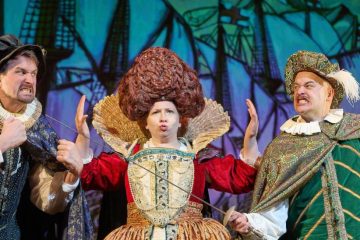
There are a few more F bombs in this comedy musical version of the Jane Austen classic, says David Simper, but the core of the story remains.
I read Pride and Prejudice some years ago and so was a little rusty on the phases of the plot. Recently I read Emma, a very different book, although with a somewhat similar ending, just to demonstrate my Austen-ista credentials. So I was fairly intrigued to see this production as I boarded my usual service 3 bus for the Grand Theatre.
This was obviously a comedy musical take on a book that has some pretty serious themes. The modern audience can miss that Austen’s female characters, normally in the lead, are saying some quite radical things for the age. Even in this version the fact that without marriage to well-resourced men, the family could be reduced to penury, hence Mrs Bennett’s occasionally screeching mania. Anyway, that’s enough English Lit.
The clock swung round to the 19:30 start time and we became aware that five young women wearing long muslin dresses appeared to be cleaning the theatre. So entered the cast, introducing themselves as the servants, as underestimated plot tools. And then we were more or less off. The title included (sort of), but I would say that the plot sticks pretty close to the original.
As the play unfolded, the story and the characters began to come back to me. The five actors switched between roles with almost bewildering speed and incredible skill. I have to say that I don’t remember Jane Austen employing the F word quite so often, in fact not at all.
The core of the story remains, two young people meet and fundamentally misunderstand each other and yet are drawn together, all amidst the practicalities of Regency marriage: she thinks he’s a posh twat, he thinks she’s a bit common. She has a mind and aspirations of her own, when really she’s not supposed to. One of the few constants in the production was Emmy Stonelake as Elizabeth Bennett, while her Darcy was also her mother. The mother was played to an extreme, rejected, alcoholic and desperate extent with an ear grating coarseness.
At one stage the question of the Napoleonic War is mentioned, with the point that this is not actually mentioned in the book. It does provide the pretext for there being soldiers around and therefore the evil Wickham and thereby his actions and thereby the shift in Elizabeth’s opinion towards Darcy.
If this doesn’t sound funny, at times the audience was beside itself with mirth. The comic timing and visual gags were incredibly well delivered. I think everybody liked the living portrait of Darcy.
All of this was tied together with popular songs, well delivered. The cast seemed to be proficient musicians as well as actors and there was live playing of various instruments thoughout, at least that’s how it came across.
As when reading Pride and Prejudice, the question ‘would they actually act like that?’ did keep coming into my mind. Well of course it is fiction, but very well grounded in the social mores of the time, so I suspect they pretty much would. I’m thinking of Darcy scotching the burgeoning romance between Bingley and Jane Bennett, which is clealy not his prerogative, but in his privilege he clearly thinks it is.
The set was nothing to write home about, but it was extremely well designed enabling the furniture for various sitting rooms to be wheeled in and out, including an unspeaking Mr Bennett and his newspaper. The production’s focus was on the action and that compensated for anachronisms such as electric standard lamps making their appearance at various junctures.
I did thoroughly enjoy this show and having read Pride and Prejudice, I was prepared to be disappointed. Congratulations to Isobel McAthur for putting this together, and to the cast for their supreme commitment. We even had a reference to the swimming scene in a certain TV adaptation.
An evening extremely well spent.
Pride and Prejudice (sort of) is at the Grand Theatre until 6th May. Tickets here.